 Luminomania

How to use a light therapy lamp: best time, how long, how close
A light therapy lamp works. But only if you use it properly, and it took me a while to figure that out.
With my first lamp, the Beurer TL35, I did my sessions every morning while working, with the lamp sitting next to my screen. The problem? At that distance, I was getting far less light than I thought. I had to bring it as close to my face as I could to really feel the effects.
So here's everything I've learned from several years of use: what time to switch your lamp on, how long to leave it on, how close to put it... and the mistakes I made, so you don't make them too.
If you only remember one thing: one session in the morning, 20 to 30 minutes at 10,000 lux, at the distance the manufacturer recommends, every day. Everything else is fine-tuning.
What time should you use a light therapy lamp?
In the morning. Ideally within an hour of waking up.
Bright morning light slows down melatonin production (the sleep hormone) and tells your brain the day has started. That's what resets your body clock. In winter, when it's still dark at 8 a.m., the lamp simply stands in for the sun that hasn't risen yet.
And it's not just a feeling. A study on winter depression led by researcher Michael Terman found that light given early in the morning worked better than the same light given later (Terman et al., Archives of General Psychiatry, 2001).
Personally, I'd switch the lamp on when I started work. Some mornings I even turned it on in bed, before getting up. Best way I found to never skip a session 😊
How late can you use it?
I'd say until late morning, early afternoon at the very latest if you get a big energy dip after lunch.
After that, I avoid it. The later the session, the more likely it is to push back the time you fall asleep, which is exactly the opposite of what you want.
What about in the evening?
No, except in very specific cases. An evening session delays melatonin and you might find yourself wide awake at midnight.
The specific cases are jet lag or night shifts, where you actually want to shift your body clock. Then the timing depends on which way you want to shift it. I explain all that in my guide on light therapy for jet lag.
How long should you use it each day?
It depends on how powerful your lamp is. The stronger it is, the shorter the session.
| Light received | Session length |
|---|---|
| 10,000 lux | 20 to 30 minutes |
| 5,000 lux | 45 to 60 minutes |
| 2,500 lux | 1 to 2 hours |
Notice the word received in the table. A lamp sold as "10,000 lux" only gives you 10,000 lux at one specific distance. If you sit further away, you get less and need a longer session. More on that just below, because it's THE trap.
If you're just starting out or your eyes are sensitive, there's nothing wrong with starting at 15 minutes and building up over a week.
And there's no point overdoing it. Sitting 2 hours in front of a 10,000 lux lamp won't do anything more, except maybe give you a headache or tired eyes. I cover this in my article on the risks and contraindications of light therapy.
To understand the link between lux and session length in detail, have a look at my guide on how many lux your light therapy lamp needs.
How close should you sit to a light therapy lamp?
This is the point almost everyone overlooks. Me included.
Light intensity drops off very quickly as you move away. A lamp that gives 10,000 lux at 15 cm can give only 2,500 at 40 cm. So the rule is simple: check the manual for the distance at which your lamp delivers its full power, and stick to it.
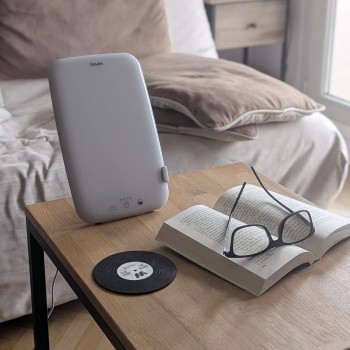
With my TL35, that distance is 15 to 30 cm. Basically with your head right in front of the lamp. In real life, when you're working on your computer, the lamp inevitably ends up further away... and it works less well.
There are two ways round it:
- bring the lamp as close as possible, even if it's a bit less comfortable;
- or get a more powerful lamp that still gives you plenty of light from further away.
That's why these days I'd rather recommend the Beurer TL95. It's still compact, but with its 14,000 lux you can put it next to your screen and actually get on with something else during the session (check the Beurer TL95 price on Amazon).
How to position yourself
No need to stare at the light. In fact, you shouldn't. The light needs to reach your eyes, but you can carry on with your day meanwhile.
What worked well for me:
- the lamp slightly off to the side (I kept mine to the left of my screen);
- roughly at eye level, or a little above;
- and meanwhile I'd read my emails, work, have breakfast.
Every now and then I'd glance at the lamp. It does no harm and helps you catch a bit more light.
When to start light therapy, and when to stop
When to start
As soon as the days get shorter. In practice, that's roughly from October, and at the latest when the clocks go back and night suddenly falls an hour earlier (I talk about it in my article on the clock change).
No need to wait until you're at rock bottom in January. It's much easier to keep a good rhythm than to get it back.
How long before you notice the effects?
For me, it happened in stages:
- energy when waking up, after a few days;
- more regular sleep, after 1 to 2 weeks;
- mood, more like after 2 to 3 weeks.
If you really feel nothing after a month of daily sessions, check the distance and the time of day first. Most of the time, that's where the problem is.
I've described everything I felt in my article on the benefits of light therapy.
When to stop
Usually in spring, when natural light comes back. You can taper off gradually, skipping a day here and there, then spacing sessions out.
But there's no hard rule. In my old flat, there wasn't enough light even in midsummer, so I used my lamp all year round. I explain why in my light therapy journey. If you spend all day in a dark office, it's pretty much the same thing.
The mistakes I made (so you don't have to)
Putting the lamp too far away
I've said it already, but it's mistake number one. For a while, my lamp sat next to my screen, at a "comfortable" distance. As a result, I was getting a fraction of the advertised power and wondering why the effect wasn't stronger.
Doing sessions irregularly
One session every three days won't do much. Your body clock likes routine. I noticed it very quickly: as soon as I skipped a few days, the morning fatigue came back.
What helped me was tying the session to something I already did every day (switching on my computer). And setting the lamp's timer so I didn't have to think about it.
Switching the lamp on too late
On days when I started late, I was tempted to do my session in the early afternoon "to catch up". Bad idea: at best it works less well, at worst you sleep worse that night. A shorter session in the morning beats a full one in the afternoon.
What about light therapy glasses?
Same principle: in the morning, every day. Except distance is no longer an issue, since the light sits right in front of your eyes. And you can move around during the session.
That's actually why I ended up switching to glasses, and why I only use my lamp now and then these days. I explain the difference in my light therapy lamp vs glasses comparison, and if you're torn between several models, my review which light therapy glasses to choose should help.
Precautions to know about
Light therapy is safe for most people, but there are a few cases where you should ask a doctor before starting:
- an eye condition (retina, glaucoma, cataract...);
- bipolar disorder;
- taking medication that makes you sensitive to light.
I'm not a doctor, so I'll point you to my full article on light therapy contraindications.
In a nutshell
- When: in the morning, within an hour of waking up. Never in the evening.
- How long: 20 to 30 minutes at 10,000 lux, longer if your lamp is weaker or further away.
- How close: the distance the manufacturer gives for full power. Often closer than you'd think.
- How often: every day, from autumn to spring (or all year if you lack light).
And if your current lamp forces you to sit with your nose practically touching it, it may just not be powerful enough for the way you use it. That's exactly what happened to me.
Further reading
- The benefits of light therapy
- Light therapy risks and contraindications
- How many lux for light therapy?
- Light spectrum in light therapy
- Light therapy glasses and jet lag: reset your body clock faster
- Morning blue light: a 2026 study confirms its benefits
- Clocks Go Back 2026: How to Change the Time and Adjust
Affiliate links: a purchase through these links earns me a small fee, at no extra cost to you.