 Luminomania

Clocks Go Back in 2026: How to Change the Time and Adjust Easily
Overnight from Saturday 24 to Sunday 25 October 2026, at 3 am it will be 2 am again in France and most of the EU. In the UK and Ireland, clocks go back from 2 am to 1 am the same night. Either way, you gain an extra hour of sleep.

The rule to change the time fits in one sentence: in autumn, clocks go back. Below you will find the settings device by device, then what this change does to your body and what I do to adjust without dragging.
How to change the time on your devices
The easiest way is to go around the house on Saturday evening, before going to bed. When you wake up, everything already shows the right time.
- Smartphone, tablet, computer, smartwatch: they change on their own if automatic time is on (Settings, Date & Time). Just check that setting;
- Oven, microwave, coffee machine: set by hand with the clock button, going back one hour;
- Car: often changed by hand from the dashboard or the central screen menu. Some GPS units do it by themselves;
- Analogue watch, alarm clock, wall clock: pull the crown or turn the dial to move the hour hand back one hour;
- Router, TV, set-top box: most update themselves. A quick look on Monday morning is enough.
If you use an old battery alarm clock, set it before you sleep. Otherwise it will ring an hour too early.
The real change happens on Sunday evening. The sun will set about an hour earlier on the clock. The hour you gain in the morning is paid back by an evening that fades sooner.
Why we still change the clocks in 2026
Since 1998, the dates have been harmonised across Europe: back to winter time on the last Sunday of October. In 2026, that Sunday falls on the 25th, which is the earliest possible date. There had not been a change this early since 2020.
The European Parliament did vote to end clock changes on 26 March 2019, by 410 votes to 192. A 2018 public consultation pointed the same way, with 84% of respondents in favour of stopping. But the Council of the European Union never approved the text, and no end date has been set. So the clocks still go back this year.
What the clock change does to you
One extra hour of sleep, but an internal clock that lags behind
Your body clock is set mainly by light. It does not read the display on your oven. On Sunday, your body will wake up as if it were still the old time, which is one hour too early on the new clock. In the evening, it will also get sleepy earlier.

It is a mini jet lag, with the same mechanism as the one explained in my jet lag guide, but over a single hour.
According to Inserm, the French national health research institute, the scientific literature links these clock changes to sleep and alertness problems, road and workplace accidents, and also depression, heart attacks and strokes. Specialists remain divided on how large these effects are. Some people notice nothing at all.
Autumn is gentler than spring
Good news: the switch to winter time is easier to handle than the switch to summer time. The European study EUCLOCK, which followed more than 5,000 people in 11 countries, shows that sleep and activity rhythms adjust easily to the autumn change. The spring change causes more trouble, especially for people who go to bed late.
Some people feel it more than others: young children, teenagers, older adults, night workers and people who already sleep badly.
Evenings that get darker
With night falling about an hour earlier on the clock, you get less light at the end of the day. That is often where it hurts, more than on the hour of sleep itself: a small slump, the urge to go to bed early, a slightly lower mood.
How to adjust to winter time more easily
Shift in small steps before Sunday
Your body has to settle one hour later. You can prepare it by going to bed and getting up 15 minutes later each day during the three days before the change. For children, 10 to 15 minutes a day is enough. The Sunday shock is already softened.
On Sunday, get up at the normal time
Even if your body wants to stay under the duvet, skip the long lie-in. Get up at your usual time on the new clock and keep your meals at fixed hours. Regular schedules are the first advice specialists give.
Get light first thing in the morning
Light is the best signal to reset your internal clock. Go outside within the hour after waking up, even for 15 to 20 minutes, even under a grey sky: it is still much brighter than your living room.
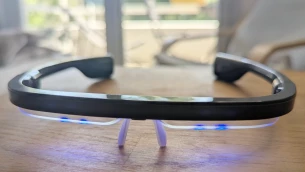 See the AYO+ glasses and their price
When it is still dark at wake-up or the weather is too bad, I fall back on my light therapy glasses. I use the AYO+ in the morning, during breakfast. They emit blue light at 470 nanometres, the same as the one tested in the 2026 study on sleep and work.
It will not cancel the clock change, but it helps your body clock reset faster. Light therapy is not a magic wand, and if you have a mood disorder or eye problems, read the precautions to know first. If you want to try, you can order the AYO+ glasses from the manufacturer's website.
In the evening, turn the light down
As night falls earlier, choose warm, dim lighting in the evening and limit screens in the hour before bed. Avoid coffee late in the afternoon and naps longer than 20 minutes. No sleeping pills or melatonin without medical advice.
In summary
On Saturday evening, put your devices back one hour before going to bed. Shift your bedtime in small steps in the days before, get up at a fixed time on Sunday and get light first thing in the morning. The autumn change remains the easier of the two, and most people get used to it within a few days.
If you want a boost to reset your body clock, my full review of the AYO+ glasses will tell you whether they suit you. To understand why light plays such a big role, also read the benefits of light therapy.
To keep reading
- The benefits of light therapy
- Light therapy risks and contraindications
- How many lux for light therapy?
- Light spectrum in light therapy
- Light therapy glasses and jet lag: reset your body clock faster
- Morning blue light: a 2026 study confirms its benefits
Affiliate links: a purchase through these links earns me a small fee, at no extra cost to you.