 Luminomania

Beat jet lag after a flight: light therapy is your secret weapon
Your body takes roughly one full day per time zone crossed to get back to its normal rhythm. On a Paris to New York flight, that's about six days of fatigue, insomnia and brain fog. Chronobiology researchers (Eastman & Burgess, PMC) have shown that timed light exposure before and during travel can significantly speed up this reset, and that's exactly where light therapy comes in.
That's why more and more business travellers and globetrotters are slipping a pair of light therapy glasses into their carry-on, right next to their sleep mask and earplugs.

Why jet lag wipes you out
Jet lag is more than just feeling tired. It's a clash between two clocks: your body's internal one, still set to your home time zone, and the local time of wherever you've just landed. That mismatch affects your sleep, but also your digestion, focus and mood.
The more time zones you cross, the longer the reset. Eastbound flights tend to hit harder than westbound ones.
Your circadian clock sits in a tiny area of the brain called the suprachiasmatic nucleus. Its main timing signal is light. That's the whole idea behind light therapy glasses: they deliver calibrated light at the right moment to tell your brain "it's morning" or "time to sleep", even when it's pitch dark or broad daylight outside. A clever way to outsmart your own biology.
How light therapy glasses actually work
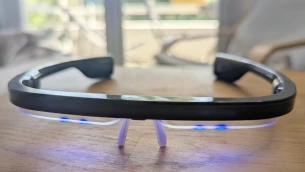 Check out the AYO+ glasses and pricing
Unlike a traditional light therapy lamp sitting on a desk, these glasses beam light through the frame, aimed at the lower part of the retina where the receptors that regulate your circadian rhythm are concentrated. The big advantage is freedom of movement: you can wear them while packing your bag, waiting to board or walking through the airport, without having to sit in front of a lamp for twenty minutes.
Sessions typically last between 15 and 30 minutes, depending on the intensity setting and the model.
When to wear them for a flight
Timing matters just as much as the device itself. Here's what to keep in mind:
Before you leave
Gradually shifting your light exposure schedule two or three days before a long-haul flight helps lay the groundwork.
During the flight
Wear the glasses based on your destination's local time, not your departure time, to speed up the switch.
On arrival
Morning light exposure helps advance your body clock (useful for eastbound flights), while late-afternoon exposure delays it (better for westbound routes).
These guidelines aren't one-size-fits-all: they depend on how many time zones you've crossed and which direction you're travelling. That's why it's worth following the protocol that comes with most recent models, which often include an app to work out the right schedule for you.

Business travel or a holiday: two very different needs
For business trips
For an executive jumping on flights for client meetings, the stakes are immediate: you need to be sharp the moment you step off the plane. Light therapy glasses become a performance tool, right up there with a strong coffee or a decent night's sleep, letting you show up clear-headed for a 9am meeting when your body thinks it's 3am.
For personal travel
When you're on holiday, the logic shifts a bit. The goal isn't necessarily to bounce back in a few hours, but to avoid wasting the first two or three days of your trip half-asleep on the beach or waking up at 4am in a hotel room. Plenty of travellers also use them on the way back, so they don't roll into the office on Monday completely wrecked.
What the research actually says
Chronobiology researchers, notably Charmane Eastman and Helen Burgess in a landmark review of anti-jet lag strategies, showed that scheduled light exposure before and during travel can shift the circadian clock more quickly, provided you get the timing right depending on your direction of travel (Eastman & Burgess, PMC). A more recent systematic review published in 2024 confirms that light ranks among the best-documented non-pharmacological interventions for reducing jet lag, alongside melatonin and gradual schedule adjustments (systematic review, PMC).
That said, keep a critical eye: light therapy isn't a magic fix. But when you combine it with common-sense habits like staying hydrated on the flight, skipping the alcohol, and trying to sleep or stay awake according to your destination's local time rather than your departure time, it makes a real difference.
How to choose light therapy glasses for travel
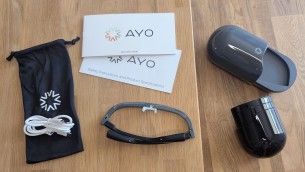 The AYO+ glasses I use, best price on the manufacturer's website
A few criteria matter more than others when you're buying for travel:
- Battery life: a USB-rechargeable model that lasts several sessions without needing daily charging is a must when you're on the move.
- Weight and size: some models weigh under 50 grams, which makes a real difference when your carry-on is already packed.
- Compatibility with prescription glasses: several brands design their frames to be worn over corrective lenses.
- Adjustable intensity: being able to fine-tune the brightness lets you adapt each session to the time of day and your own sensitivity.
I'd genuinely recommend going for connected glasses. Why? Because you don't have to worry about when to wear them or do any time zone maths. You answer a few questions, and the app guides you like a personal coach to get the most out of every session.
In a nutshell
Jet lag doesn't have to be something you just push through and wait out. Light therapy glasses offer a practical, portable and science-backed way to help your body readjust faster, whether you need to be sharp for back-to-back meetings right off the plane or just want to make the most of every day of your holiday.
Further reading
- The benefits of light therapy
- Light therapy risks and contraindications
- How many lux for light therapy?
- Light spectrum in light therapy
- Morning blue light: a 2026 study confirms its benefits
- Clocks Go Back 2026: How to Change the Time and Adjust
Affiliate links: a purchase through these links earns me a small fee, at no extra cost to you.